
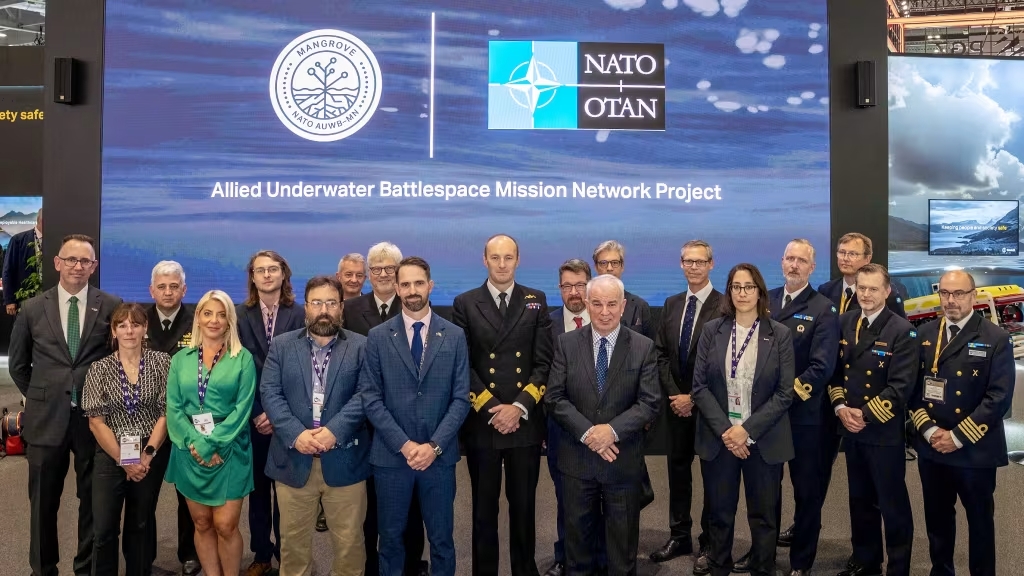
The project is designing a reference architecture for a mission network that
leverages both manned and unmanned operating systems, above and below the
water.
The mission network will facilitate rapid and secure information exchange,
supporting combined operations between all branches of the military. The
outcome is expected to become a new standard for NATO.
“Saab is delighted to lead this pivotal project for NATO. All of the MANGROVE
consortium’s expertise and collaborative focus for the next 12 months will be on
the successful development of a mission network for NATO’s operations in the
underwater battlespace. As all aspects of the underwater domain grow in their
strategic significance, this will be a critical contribution to our collective maritime
security and defence,” said Mats Wicksell, head of Saab’s business area
Kockums.
“The AUWB-MN project is a significant step forward in the modernisation of our
warfighting capabilities and the ability for NATO allies to operate effectively
together in the underwater domain of the future. We are confident that Saab and
the Mangrove consortium will deliver a robust and effective mission network that
strengthens NATO’s maritime defence,” said David Burton, Project Director,
NATO Antisubmarine Warfare Barrier Smart Defence Initiative.
The consortium was selected on 16 July, 2025 and the project is part of NATO’s
Digital Ocean and Antisubmarine Warfare Barrier Smart Defence Initiative. It is
sponsored by twelve different nations led by the UK, together with Sweden, the
US, Australia, Spain, Germany, Italy, Portugal, Canada, the Netherlands,
Denmark, and Norway. Together they have committed to adopting the standard
developed through this project.
Saab Kockums is leading the multinational consortium, MANGROVE,
comprising CETENA, FlySight, GraalTech, IDS, Miraya, Saab UK and
BlueBear, S2IX, SubSeaPulse, and the University of Plymouth.
Follow us on our Telegram channel