
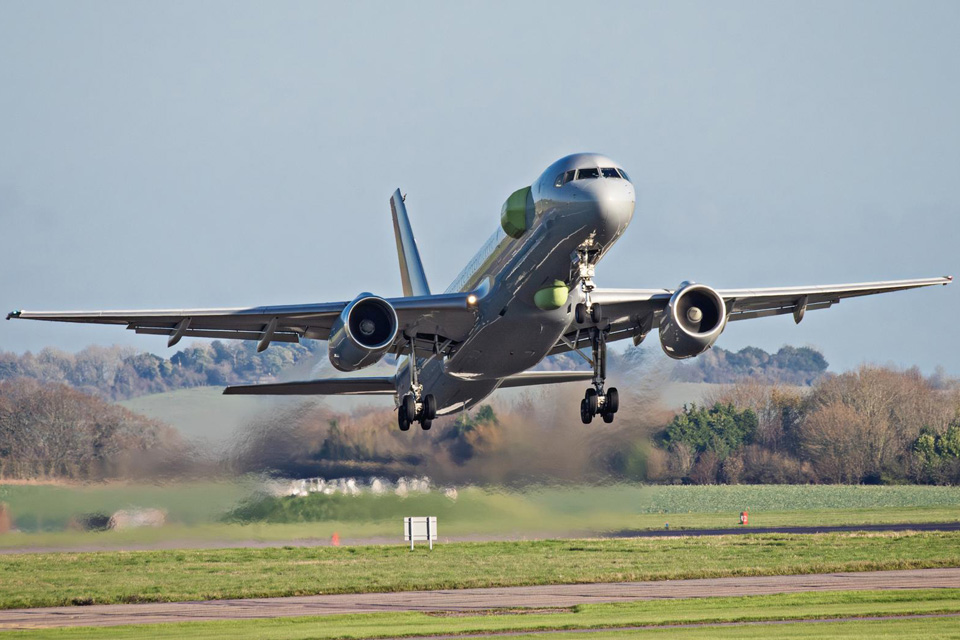
2Excel Aviation’s Boeing 757 Excalibur Flight Test Aircraft has emerged with a new radome grafted onto its nose and new fuselage fairings. The Boeing 757-200 Excalibur is being retrofitted to test new systems for the upcoming GCAP 6th-generation fighter jet known as Tempest.
Excalibur FTA has taken flight, sporting new test systems for the future Tempest fighter jet. The Boeing 757 Excalibur’s new nose radome is striking, but a common sight on test-bed aircraft when new aircraft are being developed.
In addition to the added radome, the aircraft has new forms fitted onto its existing underside fairing. The modifications are being carried out at MoD Boscombe Down in Wiltshire, England.
While not the final phase for the Tempest testbed, Excalibur is now much closer to its intended final version. The most notable additions it is expected to receive are two cheek fairings.
The 757’s first modification was completed in late 2024, with the aircraft then completing test flights. Leonardo UK stated at the time, “These pods are designed to host the Integrated Sensors, Non-Kinetic Effects (ISANKE) and Integrated Communications Systems (ICS).”
Excelibur (registered G-FTAI) was built in 2000 and delivered to the Spanish flag carrier, Iberia. It subsequently flew for a range of airlines until it was acquired by 2Excel Aviation in March 2023.
It is an airborne demonstrator and flying laboratory to test communications equipment, various sensors, radars, and more for the upcoming Tempest.
The Aviationist reports 2Excel also acquired a second 757 (G-BYAW). That aircraft was disassembled and “reproduced virtually in order to create a fully accurate digital twin” of Excelibur. Two more testbeds, one Japanese and one Italian, are expected to join Excelibur in the coming years.
The appearance of the modified Excelibur drew comparisons to the US’s Boeing 757 ‘Catfish’ testbed that was used to develop the F-22 Raptor. Some also pointed to the Boeing 737 ‘Catbird’ built to support the F-35 programme.
The UK has modified other aircraft, including a BAC One-Eleven (registered ZE433) and a BAe 146 (G-ETPL), as testbeds for the Typhoon and other aircraft.
A Tempest demonstrator is now being built by BAE Systems and is expected to fly in 2027. The ambitious plan is for the type to enter service by 2035 as Japan feels it has a more urgent need for a next-generation fighter as China modernises. The UK is less hurried as its main future threat is Russian systems.
Follow us on our Telegram channel