
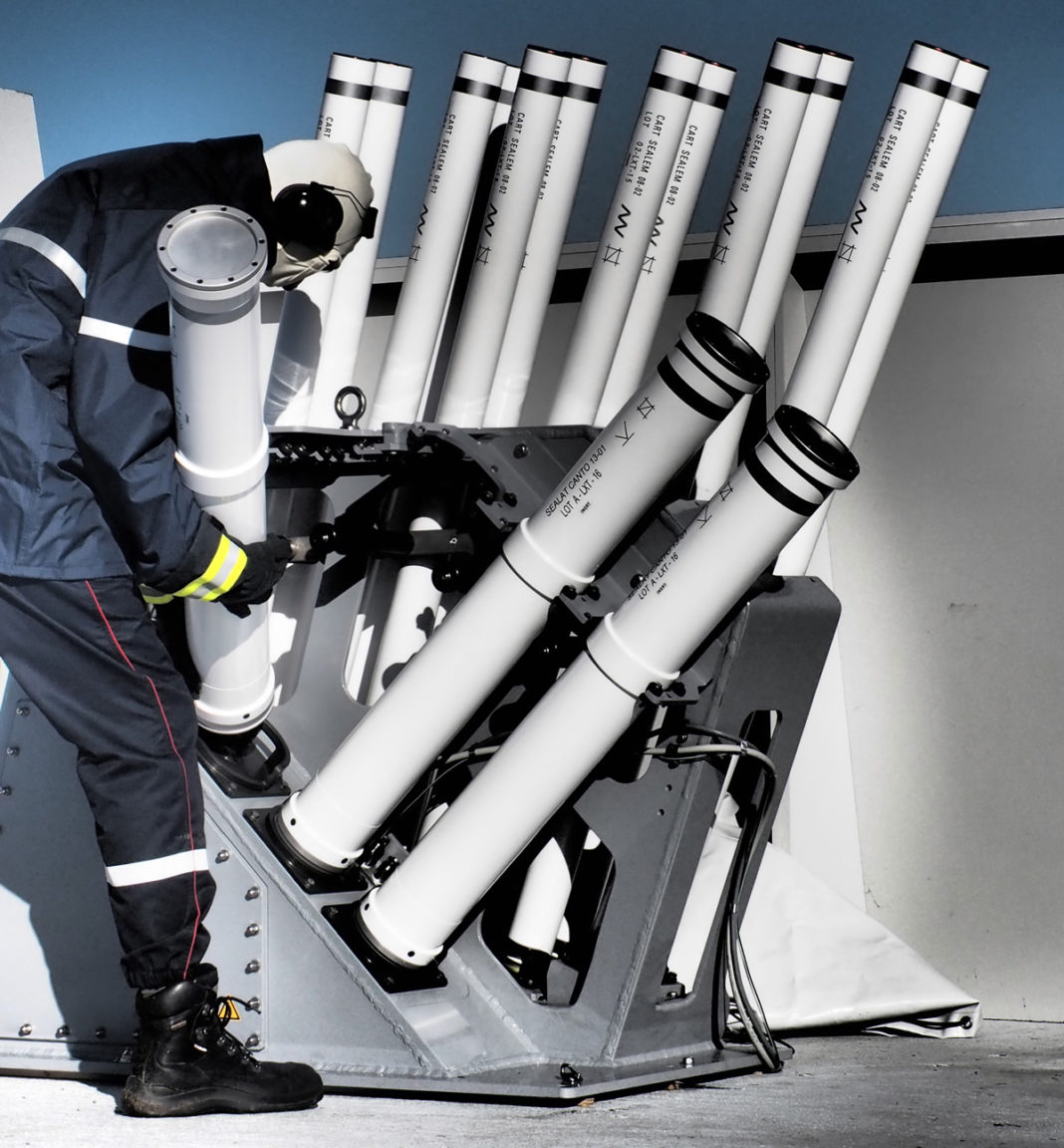
- The agreement will see the partners integrate Leonardo’s MJTE anti-torpedo
countermeasures with LACROIX’s SYLENA MK2 decoy launching system - The SYLENA MK2, which can fire a variety of countermeasures, to protect ships from
OPV to large frigates, allows the expansion of MJTE market to reach small and
medium-sized of vessels
Leonardo and LACROIX have signed a strategic agreement which will see the
partners working together to develop and integrate solutions in the naval countermeasures sector. The
collaboration, which will look towardsnew technologies as well as new business opportunities, initially provides
for the creation of the SYLENA Mk2/MJTE solution. This will see LACROIX’s SYLENA MK2 DLS (Decoy
Launching System) integrated with Leonardo’s MJTE (Mobile Jammer Target Emulator) anti-torpedo
countermeasures.
The MJTE is Leonardo’s latest-generation torpedo jamming solution. It can emulate the signature and
acoustics of its host platform and emit a powerful jamming signal to create convincing false targets, allowing
the targeted vessel to perform an effective evasive manoeuvre. Compared to other solutions on the market,
the new MJTE packs a number of protective techniques into a low cost unit and performs effectively at short
range.
The MJTE is part of Leonardo’s new anti-torpedo suite, which includes the towed Black Snake sonar, the new
OTO Decoy Launching System 20 (ODLS20) and the company’s software package which calculates optimum
release timing for countermeasures and escape routes for the host vessel.
The cooperation agreement between Leonardo and LACROIX will expand the accessible market for both the
MJTE countermeasure and the SYLENA MK2 launch system. The compact and lightweight form factor of the
SYLENA MK2 makes it suitable for small and medium-sized vessels, expanding the potential user base for
the MJTE. Meanwhile the cutting-edge new capabilities brought by the MJTE will improve the utility of the
SYLENA MK2 system.
Andrea Padella, Head of Defense Systems, Leonardo Electronics said: “This agreement reaffirms Leonardo’s
ability to interpret, respond to and often anticipate market needs. There is clear synergy in this partnership with
LACROIX as together we can offer a sophisticated anti-submarine countermeasure solution,even forplatforms
with limited space. These require compact and lightweight launch systems which can simultaneously deliver
Anti-Air Warfare and Anti-Submarine capabilities”.
Leonardo is committed to securing and protecting people and communities around the world through its
leadership in next generation technologies. Collaboration within industry, with government and between
individuals to offer superior security capabilities is part of its ‘Be Tomorrow – Leonardo 2030’ strategic plan.
François MOULINIER, COO of LACROIX Defense said: “Following the work we have undertaken with
Leonardo to integrate SYLENA within their Athena-C combat management system as part of ongoing
contracts, this collaboration is a natural next step in the development of joint solutions. Leonardo is a major
player in the European Industrial and Technological Defense Base (BITD) and this partnership proves the
maturity of our solutions and the unmatched modularity and versatility of our range of systems.”
Following its customers’ requests, LACROIX has developed, since 2012, a range of new generation Decoy
Launching Systems (DLS) to protect and significantly increase vessel survivability ratio, from patrol boats
operating the SYLENA® Lightweight to destroyers operating the SYLENA® MK1 and MK2. SYLENA®
launchers are capable of employing the latest generation of SEACLAD® ammunition, corner reflectors and IR
decoys as well as ASW solutions with the SEALAT dedicated to the SYLENA® MK2.
The SYLENA® MK2 DLS, which is the first “in-service” static anti-missile system in the world operating both
corner reflectors (SEALEM) and anti-torpedo countermeasures, maximizes vessel protection with a highly
reliable system at a low operating cost.
The fact that the SYLENA® DLS static launcher fires only mortars without any pneumatic constraints and has
a low footprint on deck along with a low recoil force allows for limited acquisition and integration costs.
Therefore the system has already convinced numerous navies to either retrofit or fit out their vessels.